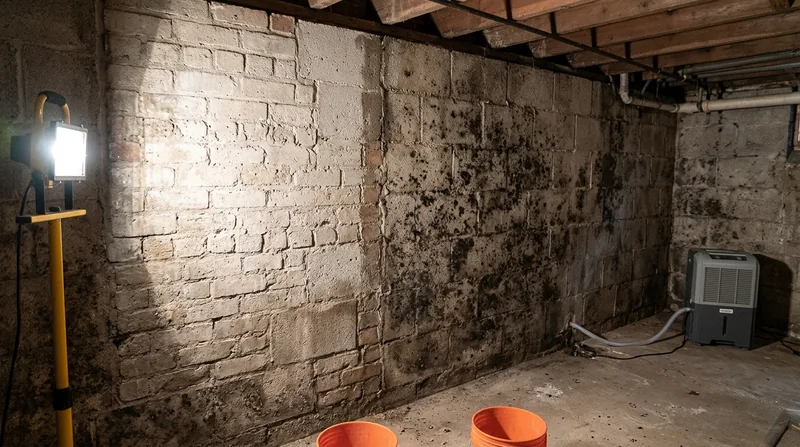




Basement Mold Remediation in New York City
If you smell that musty, wet-earth odor the moment you open the cellar door in a Park Slope rowhouse or a Forest Hills Tudor, you are dealing with Basement Mold Remediation in New York City territory, not a cleaning problem. The mold is the symptom; the moisture is the cause. In this city the moisture almost always traces to hydrostatic pressure pushing water through old brick or stone foundation walls, a failed drain tile line under the slab, or a sump pump that quit during the last nor'easter. We remediate the affected surfaces and then fix the water path so the growth does not return next season. Our work is strictly below grade and residential, on cellars, full basements and masonry foundations. If you want the full picture of how we stop water at the wall, see our basement waterproofing service.
Why Mold Takes Hold in New York City Cellars and Basements
New York City sits on fill, glacial sand and clay over bedrock schist, and the water table runs shallow near the harbor and the tidal rivers. That means a basement slab here is often sitting in damp ground, not dry ground. Add freeze-thaw winters that open hairline cracks in brick and block, nor'easter downpours that overwhelm grading, and 1920s drain tile that has long since silted shut, and you have the recipe for recurring damp. The dominant failure mode in this city is hydrostatic pressure driving water through foundation walls and cold joints after heavy rain.
- Old brick and stone foundation walls in Brooklyn and Manhattan brownstones wick groundwater and stay damp for weeks.
- Block and poured walls in Queens and the Nassau suburbs crack at the cove joint and let water in during spring thaw.
- Failed footing drains under 1950s split-levels in White Plains and New Rochelle back up and saturate the slab.
- Sump pumps that trip a breaker or lose power in a storm leave standing water that feeds mold within days.
Each of those paths delivers moisture to organic material (wood framing, paper-faced drywall, stored cardboard), and that is what mold colonizes.
Key info: A cellar in Bay Ridge that floods once every spring can grow visible mold on joists and stair stringers within 48 to 72 hours of the water receding. The remediation is only as good as the drainage fix behind it.
For official guidance on moisture and mold in housing, see the NYC Department of Health mold information page. It is a useful reference for homeowners sorting out what is a moisture problem versus a cleaning problem.
How We Run Basement Mold Remediation in New York City
We do not fog a basement and call it done. Our sequence starts with finding the water source, because remediation without moisture control is a repeat job. We inspect the foundation walls, the cove joint, the slab, the sump basin and the window wells, and we read the efflorescence pattern to see where water has been migrating. Then we contain, treat and dry.
- We set up containment with poly sheeting and negative air pressure so spores do not spread to the living space above.
- We remove porous materials that cannot be saved, such as saturated drywall, insulation and cardboard.
- We HEPA-vacuum and treat affected framing and masonry with an antimicrobial application.
- We dry the space with commercial dehumidifiers and air movers and verify moisture readings before closing up.
- We correct the water path with crack injection, interior perimeter drain, sump replacement or grading, depending on what the inspection shows.
In a Jackson Heights attached brick house, that often means an interior drain tile system tied to a new sump basin, because exterior excavation between attached homes is not practical.
Key info: In a St. George house on a Staten Island hill, we found the mold was fed by a window well that filled during every heavy rain. Cleaning the wall alone would have failed by the next storm.
Remediation and Moisture-Control Approaches We Use
Not every basement needs the same scope. We match the approach to the moisture reading and the wall condition, and we tell you plainly when simple crack sealing is enough and when hydrostatic pressure means drainage is the real answer.
| Approach | Description | Best for |
|---|---|---|
| Surface remediation and treatment | Containment, HEPA vacuuming, removal of porous material, antimicrobial treatment of framing and masonry. | Localized growth from a one-time leak or humid summer. |
| Crack injection plus wall sealing | Epoxy or polyurethane injection into cracks, then parging or sealing the wall face. | Seepage through a defined crack in a poured or block wall. |
| Interior perimeter drain and sump | Interior drain tile at the footing, new sump basin and pump, discharge line with check valve. | Hydrostatic pressure and wet slabs that return every rain. |
| Dehumidification and ventilation | Permanent dehumidifier sized to the basement volume, plus vapor barrier on the walls. | Chronic damp and musty odor without standing water. |
| Exterior drainage correction | Footing drain repair, waterproof membrane and dimple board where excavation is possible. | Detached houses where the exterior wall is accessible. |
Basement Mold Remediation Cost in New York City: What to Expect
Most basement mold remediation jobs in New York City start at about $1,500, and that figure covers containment, treatment and drying for a contained area. The number moves with square footage affected, how much porous material has to be removed, whether the space is a finished basement with studs and drywall, and how much of the moisture fix is bundled in. A single damp wall in a Hempstead Cape Cod is a different job than a full cellar in a Bedford-Stuyvesant brownstone.
Because the moisture fix is part of the scope, we quote remediation and drainage together so you can see what each piece costs. Factors that push the price up include limited access through narrow cellar stairs, the need for a new sump pump and discharge line, and the presence of bowing walls that need structural attention before anything else. Getting two or three estimates is smart here, because scope varies widely between contractors. Our full pricing overview breaks down the ranges in more detail.
Hiring a Basement Mold Remediation Contractor Near Me in New York City
When you search for a basement mold remediation contractor near me in New York City, the first filter is licensing and insurance. Ask for the certificate of insurance and confirm the company carries liability and workers' compensation coverage. Get at least two written estimates that separate remediation from the moisture fix, and ask for references from jobs in your borough.
Permits matter when the work touches structural repair, egress windows or the sanitary connection of a sump discharge, and the rules vary by jurisdiction, so confirm with your local building department before work starts. Ask how the contractor will handle containment and how they will verify the basement is dry before closing up. You can reach us through our contact page to set up a free inspection.
Basement Mold Remediation in New York City: Pricing Guide
| Service | Price | Details |
|---|---|---|
| Contained surface remediation | Starting at $1,500 | Includes containment, HEPA vacuuming, antimicrobial treatment and drying for one affected area. |
| Remediation plus crack injection | Starting at $2,400 | Adds epoxy or polyurethane injection and wall sealing where seepage comes through a defined crack. |
| Remediation plus interior drain and sump | On estimate | Priced after inspection because linear footage, sump location and discharge routing vary by basement. |
| Finished basement with framing removal | On estimate | Cost rises with studs, drywall and insulation that must be removed and replaced. |
| Travel | Included | In New York City and surrounding areas, no separate call-out or mileage fee. |
| Estimate | Free | Response within 24h at (929) 392-2158, no obligation to book. |
Indicative pricing, the exact cost depends on square footage, finish, and site access. Free personalized estimate within 24h at (929) 392-2158.


