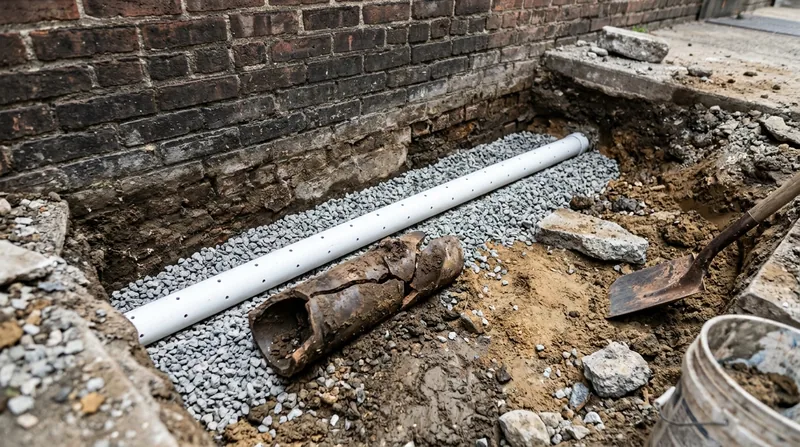




When you need Drain Tile Repair & Replacement in New York City, the first thing to understand is that most of the footing drains under this town were never built to last a hundred years. In Brooklyn's Park Slope and Bay Ridge, in the brick rowhouses of Bedford-Stuyvesant, and under the Tudor and attached homes of Forest Hills and Jackson Heights, the original weeping tile is often clay or cast-iron laid in the 1920s through the 1950s. Those lines are now cracked, root-bound, or silted solid with glacial sand and clay. The result is water finding its way to the footing and then into the basement, long after the drain that was supposed to carry it away has quit. We camera the line, find the break, and replace the failed section with modern PVC so the foundation drain actually drains again. If you are chasing water across a cellar floor, start with a free basement inspection before you spend a dollar on anything else.
Why Failed Footing Drains Are the Hidden Cause of Wet Basements Across New York City
The ground here is a mix of fill, glacial sand and clay sitting over bedrock schist, and the water table runs shallow near the harbor and the tidal rivers. When the footing drain clogs or collapses, that groundwater has nowhere to go but against the foundation wall, and hydrostatic pressure does the rest. You see it as efflorescence on the brick, a musty basement smell, or a wet seam that shows up a day after a hard rain. The drain is the part nobody sees, and it is usually the part that failed first.
- Original clay tile joints shift and separate as the house settles, letting soil wash into the line.
- Tree and shrub roots from street trees and backyard plantings invade the joints and choke the pipe.
- Cast-iron footing lines rust through from the inside and collapse under the weight of the backfill.
- Glacial clay soil silts up the pipe over decades until flow drops to a trickle.
- Downspouts and grading that dump water at the wall overwhelm a drain that is already half blocked.
Any one of these is enough to turn a dry cellar into a wet one, and most older homes here have two or three working at once.
Key info: A brownstone in Manhattan's Upper West Side with a stone rubble foundation and a 1910s clay footing line is a very different repair from a 1955 split-level in White Plains with a poured wall and a block-and-perforated-pipe drain. The camera inspection tells us which one you have before we quote a number. For the official line on what needs a permit, check the NYC Department of Buildings and confirm with your local building department, since rules vary by jurisdiction.
How We Repair and Replace Drain Tile in New York City, Step by Step
We do not guess at a drain problem from the basement floor. The work starts with a camera pushed through the line to see exactly where it is broken, root-bound, or silted, and how deep the footing sits. From there we choose the least invasive fix that actually solves the drainage, whether that means a targeted spot repair or a full replacement of the perimeter run. On many homes the better answer is an interior drain tile system tied to a sump basin, because it captures water at the floor-wall joint without tearing up the yard or the stoop.
- We camera the existing footing drain and mark the breaks, root intrusions, and low spots on a sketch.
- We test flow and check the sump basin, pump, check valve, and discharge line for the whole system.
- We excavate only where the line has failed, keeping the work tight to the foundation and away from mature trees.
- We lay new perforated PVC in a washed-stone bed with the correct fall to the sump or storm connection.
- We backfill, compact, and restore grading so surface water still runs away from the wall.
- We run a flow test and show you the camera footage of the new line before we call the job done.
That sequence is what keeps a repair from becoming a repeat visit two winters later.
Key info: In Riverdale and St. George, where stone and brick houses sit on sloped ground, we often find the footing drain daylighting halfway down the hill instead of reaching a storm line. We re-route it to a proper discharge and add a sump pump installation so the line has somewhere to empty during a nor'easter surge.
Repair Approaches We Use on New York City Footing Drains
Not every failed drain needs the same treatment. A single crushed section under a stoop is a spot repair; a line that is root-bound end to end is a replacement. The table below shows how we match the approach to the condition we find on the camera.
| Approach | Description | Best for |
|---|---|---|
| Targeted spot repair | Excavate and replace one failed section with PVC, leaving intact line in place. | A single crush, offset joint, or root intrusion on an otherwise sound line. |
| Full perimeter replacement | Remove the old clay or cast-iron run and lay new perforated PVC in washed stone. | Lines that are collapsed or silted solid from end to end. |
| Interior perimeter drain | Cut a channel at the floor-wall joint and lead water to a sump basin. | Finished basements and homes where exterior excavation is not practical. |
| Sump and discharge tie-in | Connect the repaired drain to a sump basin with pump, check valve, and discharge line. | Low coastal blocks and any line that cannot gravity-feed to a storm sewer. |
| Root and silt clearing | Machine-cut roots and jet the line, then camera to confirm flow. | Drains that are blocked but structurally intact. |
We pick the approach from the footage, not from a sales script, and we tell you plainly when a simple clearing will do.
Drain Tile Repair & Replacement Cost in New York City: What to Expect
Pricing starts at $750 for a targeted spot repair with camera inspection, and climbs from there based on how much line has to come out and what sits above it. A full perimeter replacement on a long rowhouse lot, or a job under a finished basement floor in Forest Hills, costs more than a short run under a stoop in Bay Ridge. Access is the big driver: a line under a concrete stoop, a mature street tree, or a shared driveway takes more time and care than an open side yard. That is why we quote from the camera footage and the site, not over the phone.
Get two or three written estimates and compare what is actually included, not just the bottom line. Ask whether the price covers camera inspection, excavation, new PVC, stone bedding, backfill, and a flow test, because a cheap number that skips half of that is not a bargain. Our full pricing overview lays out how the ranges break down, and the estimate itself is free.
What to Look for When Hiring a Drain Tile Repair & Replacement Contractor Near Me in New York City
This is below-grade work, and the wrong contractor can leave you with a line that looks fine and fails at the first nor'easter. Start with licensed and insured status and ask for the certificate, not just a promise. Get at least two or three estimates in writing, and make sure each one names the camera inspection, the materials, and the flow test. Ask for references from jobs in your borough and call them. If the work alters drainage or the sanitary connection of a sump discharge, confirm the permit requirements with your local building department before anyone breaks ground, since thresholds vary by jurisdiction. And if your block has any shared or protected plantings, check the rules before excavation starts.
You can reach us at our contact page to set up the free inspection and get a written scope. We tell you what the camera shows and what it will take to fix it, and we say so when a simple repair is all you need.
Drain Tile Repair & Replacement in New York City: Pricing Guide
| Service | Price | Details |
|---|---|---|
| Targeted spot repair | Starting at $750 | Includes camera inspection, excavation, new PVC section, stone bedding, backfill, and flow test. |
| Full perimeter replacement | Starting at $2,400 | Removes old clay or cast-iron line and lays new perforated PVC; price moves with run length and access. |
| Interior perimeter drain tie-in | Starting at $3,200 | Cuts floor-wall channel to sump basin; finished floors and long runs raise the figure. |
| Sump and discharge connection | Starting at $1,100 | Adds sump basin, pump, check valve, and discharge line where the drain cannot gravity-feed. |
| Complex or large-scale job | On estimate | Long runs under stoops, shared driveways, or mature street trees need an on-site look first. |
| Estimate | Free | Response within 24 hours at (929) 392-2158, no obligation to book. |
Indicative pricing, the exact cost depends on square footage, finish, and site access. Free personalized estimate within 24h at (929) 392-2158.


