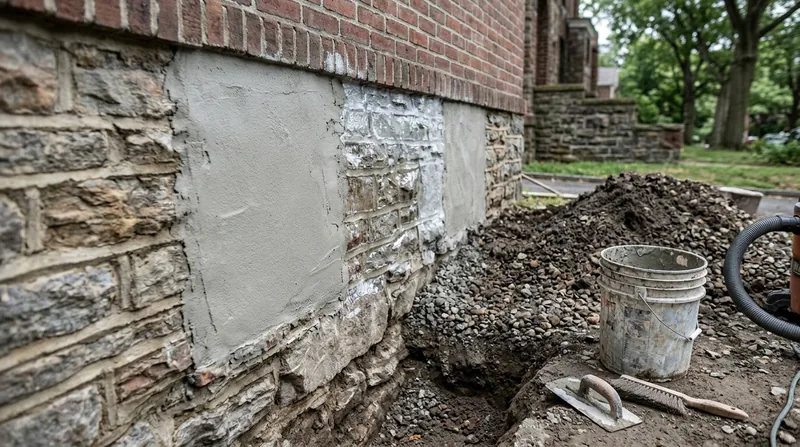




Foundation Waterproofing in New York City: Built for Old Brick, Stone, and Fill Ground
When you need Foundation Waterproofing in New York City, the ground under your house matters more than any brochure. Much of this city sits on fill, glacial sand, and clay over bedrock schist, with a shallow water table near the harbor and tidal rivers. That means hydrostatic pressure pushes water against foundation walls long after the rain stops. In Brooklyn's Park Slope and Bay Ridge, pre-war brick rowhouses with full basements take that pressure through old mortar joints. In Queens, the attached brick and Tudor homes of Forest Hills and Jackson Heights sit on block and poured walls that crack along cold joints. Out in the Bronx and Staten Island, brick and stone houses on the hills of Riverdale and St. George shed water downslope into footing drains that are often clogged or collapsed. We match the treatment to the wall you actually have: parging and crack repair on soft brick, membrane or crystalline treatments on poured and block walls, and drainage correction where the water has nowhere to go. Start with a free basement inspection so we can tell you plainly whether you need crack sealing or a real drainage fix.
Why Foundation Waterproofing Matters in New York City's Older Housing Stock
New York City basements fail for reasons that have nothing to do with a storm last week. Rubble-stone and soft-brick foundation walls from the 1890s through the 1930s were never built with a waterproof membrane, and their lime mortar erodes under constant wetting. Freeze-thaw winters open hairline cracks into real ones. Nor'easter surge and flash-flood downpours push water against low coastal blocks in Long Beach and Valley Stream. The result is the same in every borough: efflorescence on the wall, a musty basement smell, and water after rain that keeps coming back.
- Hydrostatic pressure forces water through mortar joints and porous brick, not just through visible cracks.
- Clogged or collapsed footing drains and weeping tile leave water sitting against the wall instead of carrying it away.
- Failed parging and deteriorated mortar let water wick into the wall core and show up as damp patches high on the foundation.
- Poor grading and short downspout extensions dump roof water right at the foundation line.
- Old stone and brick walls bow inward when saturated soil pushes against them season after season.
Fixing the drainage and the wall surface together is what stops the cycle, and doing one without the other usually means a callback next spring.
Key info: A 1920s brick rowhouse in Bay Ridge with efflorescence and damp patches at the wall base usually has a footing drain problem, not a crack problem. Sealing the wall alone traps the moisture behind the coating and pushes it higher. We check the drain before we quote any surface treatment.
For the official rules on foundation and drainage work, always verify with the NYC Department of Buildings, since permit thresholds vary by scope and borough.
How We Waterproof a Foundation in New York City, Step by Step
We do not sell one system to every house. A poured-wall Colonial in Garden City and a rubble-stone cellar in Manhattan need different work, and we scope each one on site. The inspection tells us the wall type, where the water is entering, and whether the footing drain is still doing its job. From there we build the sequence that fits your foundation and your access.
- We walk the basement and the exterior grade, map the damp areas, and check the footing drain and sump basin.
- We open and clean cracks, then inject them with epoxy or polyurethane depending on whether the crack is structural or active.
- We repair parging and repoint deteriorated mortar on brick and stone walls with compatible materials.
- We correct grading and extend downspouts so roof water discharges well away from the foundation.
- We apply the waterproof membrane or crystalline treatment suited to the wall type, then verify the drain path.
Every step gets documented with photos so you can see what was done and why.
Key info: On a 1930s Tudor in Forest Hills, we found an active vertical crack at a cold joint plus a crushed clay footing drain. We injected the crack with polyurethane, replaced the failed section of drain tile, and re-parged the wall. Two separate problems, one visit, and no excavation of the interior slab.
If the inspection shows the water is coming through the wall face across a wide area rather than at cracks, the better answer is often an interior drain tile system that captures water at the footing and routes it to a sump basin.
Foundation Waterproofing Methods We Use in New York City
The right method depends on wall material, water source, and whether the problem is a single crack or the whole wall face. Here is how we match the approach to the foundation.
| Approach | Description | Best for |
|---|---|---|
| Epoxy injection | Structural-grade epoxy injected through ports to rebond a settled or cracked wall. | Non-active structural cracks in poured and block walls. |
| Polyurethane injection | Flexible foam that expands and seals cracks that are still moving with the seasons. | Active leaks and wet cracks after rain. |
| Parging and repointing | Compatible mortar applied to restore the wall face and stop wicking. | Soft-brick and rubble-stone foundation walls. |
| Waterproof membrane or crystalline coating | Surface treatment that blocks water at the wall face. | Poured and block walls with broad damp areas. |
| Drainage correction | Grading, downspout extensions, and footing drain repairs that move water away. | Homes where hydrostatic pressure is the real driver. |
We often combine two or three of these on one house, and we tell you when a single crack seal is genuinely all you need.
Foundation Waterproofing Cost in New York City: What to Expect
Most foundation waterproofing work in New York City starts from $3,500 and moves up from there. That starting figure typically covers crack injection and surface treatment on an accessible wall. The price climbs when the scope grows: a full perimeter drainage correction, a rubble-stone wall that needs repointing, or a job where the basement is finished and we have to protect flooring and contents. Access matters too, since a rowhouse with a shared party wall in Bedford-Stuyvesant is a different job than a detached Colonial in White Plains with open grade on three sides.
Wall material is the biggest single factor. Soft-brick and rubble-stone walls take more labor than poured concrete because the repair has to match the original mortar. Active leaks that need polyurethane injection cost less than a wall that is bowing and needs structural attention. Getting two or three written estimates is smart, and so is asking each contractor to explain what they found and why their method fits. Our full pricing overview lays out the ranges by scope so you can compare like for like.
Foundation Waterproofing Near Me: How to Vet a Contractor in New York City
Hiring the right contractor matters more than the brand on the truck. Ask for proof of licensing and insurance, and get a certificate of coverage before work starts. Get at least two or three estimates in writing, each with the method, materials, and scope spelled out. Ask for references from jobs in your borough and call them.
- Confirm the contractor is licensed and insured and can show a certificate on request.
- Get multiple written estimates so you can compare scope, not just the bottom line.
- Check references from similar foundation types in your area.
- Ask whether the work needs a permit from the local building department, since structural repair and drainage alterations often do.
- Understand any co-op or HOA rules before scheduling work that affects shared walls or common areas.
If a contractor cannot explain the difference between a crack seal and a drainage fix, keep looking. Reach us through the contact page to schedule your inspection.
Foundation Waterproofing in New York City: Pricing Guide
| Service | Price | Details |
|---|---|---|
| Crack injection and sealing | Starting at $3,500 | Covers opening, cleaning, and injecting accessible cracks plus surface treatment on one wall area. |
| Parging and repointing | Starting at $4,800 | Restores soft-brick or rubble-stone wall faces with compatible mortar and stops wicking at the surface. |
| Perimeter drainage correction | On estimate | Scope depends on footing drain condition, access, and whether interior excavation is required. |
| Travel | Included | in New York City and surrounding areas, no separate call-out or mileage fee |
| Estimate | Free | Response within 24h at (929) 392-2158, no obligation to book |
Indicative pricing, the exact cost depends on square footage, finish, and site access. Free personalized estimate within 24h at (929) 392-2158.


