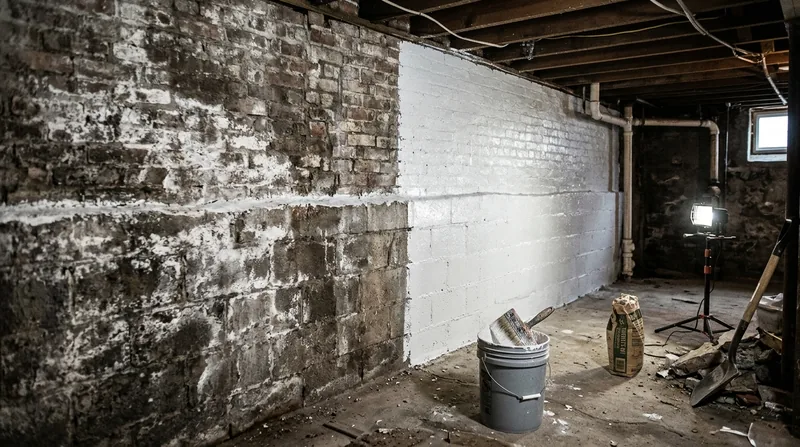




If you own a pre-war brick rowhouse in Park Slope or a Tudor in Forest Hills, you already know that dampness in a cellar is a fact of life. The ground here is fill, glacial sand and clay sitting over bedrock schist, and the water table runs shallow near the harbor and the tidal rivers. That means Basement Wall Sealing in New York City is rarely a cosmetic upgrade. It is the first line of defense against efflorescence bloom, peeling paint, and that musty smell that creeps up the stairs every spring. We work below grade only, on brick, block, stone, and poured walls, from Bedford-Stuyvesant cellars to 1920s brick Colonials in White Plains. Our job is simple: tell you honestly whether you have a surface dampness problem or active hydrostatic pressure, then seal the wall the right way. Start with a free basement inspection so we can see what the wall is actually doing.
Why Basement Wall Sealing Matters in New York City's Old Masonry Stock
Most basements we open up in Brooklyn, Queens, and the Bronx are 80 to 120 years old. The brick and stone foundation walls were laid with lime mortar, not Portland cement, and they were never meant to hold back a shallow water table under hydrostatic pressure. Freeze-thaw winters push water into hairline cracks, and nor'easter downpours overwhelm the old footing drains. Sealing the wall stops the vapor drive and the seepage at the surface, which is often enough when the problem is dampness rather than a running leak.
- The sealer blocks capillary suction so brick and block stop wicking groundwater into the cellar.
- We remove efflorescence and the salt bloom before any coating goes on, because sealer over salt will blister.
- Weeping mortar joints and spalled brick get repointed and parged before sealing so the wall has a sound face.
- A penetrating sealer leaves the masonry breathable, which matters on old lime-mortar walls that need to dry inward.
When the wall is wet to the touch after every rain, though, a sealer alone will not hold back pressure, and we will tell you that on the spot.
Key info: A brownstone cellar in Manhattan's Upper West Side showed heavy white efflorescence and damp brick but no standing water. Sealing and repointing solved it. A block wall in Bay Ridge with water weeping at the cove joint after every storm needed an interior perimeter drain instead. Same symptom, different cause, different fix.
For the official word on what counts as structural foundation work and when a permit is required, check the NYC Department of Buildings before any repair goes beyond surface sealing.
How We Seal a Basement Wall in New York City, Step by Step
Every wall gets the same disciplined sequence, whether it is a poured wall in a 1950s Cape Cod in Hempstead or a stone foundation under a St. George house on Staten Island. We do not skip the prep, because 80 percent of sealer failures are prep failures. Here is the order we work in.
- We inspect the wall for active cracks, bowing, and hydrostatic pressure before we quote any sealing work.
- We wire-brush and scrape the wall, then remove efflorescence with a masonry-safe cleaner and let it dry.
- We fill hairline cracks and open mortar joints with hydraulic cement or epoxy injection where the crack is structural.
- We apply a parge coat to rough stone or spalled brick so the sealer has a flat, sound surface.
- We roll or spray the penetrating or membrane sealer in two coats, then check coverage with a moisture meter.
- We extend downspouts and correct grading so roof water stops dumping against the same wall.
If the inspection shows pressure rather than dampness, we route you to the right system instead of selling a coating that will fail.
Key info: A two-family in Flushing had a block wall that read damp year-round but never puddled. Two coats of penetrating sealer plus a downspout extension fixed it for a fraction of what a drain system would cost. We told the owner that plainly before writing the estimate.
When the diagnosis points to water coming up through the cove joint or the footing, the better answer is an interior drain tile system, which relieves pressure instead of fighting it from the inside face.
Sealing Approaches We Use on New York City Basement Walls
Not every wall takes the same product. Lime-mortar brick needs to breathe, poured walls can take a membrane, and a wall with active seepage needs crack injection before any coating. This table shows what we use and when.
| Approach | Description | Best for |
|---|---|---|
| Penetrating sealer | Sinks into the masonry and blocks capillary suction while leaving the wall breathable | Damp brick and block walls with efflorescence but no running water |
| Membrane sealer | Flexible elastomeric coating that bridges hairline cracks and resists mild pressure | Poured walls and block walls with minor seepage at the joints |
| Crack injection plus sealing | Epoxy or polyurethane injection through ports, then sealer over the repaired face | Walls with a defined vertical or diagonal crack that leaks during rain |
| Parging and repointing | Rebuilds spalled mortar joints and gives rough stone a flat, sound face before sealing | Old stone and brick foundations in brownstones and pre-war rowhouses |
| Drainage correction | Regrades soil and extends downspouts so roof and surface water move away from the wall | Walls that only get wet after heavy rain or snowmelt |
Basement Wall Sealing Cost in New York City: What to Expect
Most residential wall sealing jobs here start around $1,500, and that figure covers a straightforward wall with surface dampness, efflorescence removal, and two coats of sealer. From there the number moves with wall length, how much prep the masonry needs, and whether we find active cracks that need injection first. A single damp wall in a Valley Stream split-level sits near the low end. A full cellar perimeter of spalled stone in a Park Slope brownstone, with repointing and parging, lands well above it.
Access is the other big driver. A cellar with a narrow bulkhead and low headroom takes longer than an open basement with a walkout. If we find hydrostatic pressure, the honest recommendation may be a drain system rather than a coating, and we will show you why before you spend a dollar on sealer. Get two or three written estimates, ask what prep is included, and be wary of any quote that promises a coating will stop a running leak. Our full pricing overview breaks down the ranges in more detail.
How to Choose a Basement Wall Sealing Contractor Near Me in New York City
Sealing a basement wall looks simple until a coating peels off in two years because nobody removed the efflorescence or checked for pressure. Ask three questions before you hire. First, is the contractor licensed and insured, and can they produce a certificate of insurance on request? Second, will they inspect the wall and tell you if sealing is the wrong fix? Third, do they pull permits where the work touches structural repair or drainage connections, and do they know the local building department's thresholds?
Check references on jobs similar to yours, especially old brick and stone walls, because modern block and poured walls behave differently. If your building is in a historic district or under a co-op board, confirm what the board requires before work starts. A contractor who hesitates on any of these questions is not the one you want in your cellar. Reach out through our contact page and we will walk the wall with you.
Basement Wall Sealing in New York City: Pricing Guide
| Service | Price | Details |
|---|---|---|
| Single wall sealing | Starting at $1,500 | Includes efflorescence removal, surface prep, and two coats of sealer on one wall |
| Full basement perimeter sealing | Starting at $3,200 | Covers all four walls with prep and sealer; wall length and headroom access move the price |
| Crack injection plus sealing | Starting at $2,100 | Epoxy or polyurethane injection through ports before the sealer goes on the wall face |
| Parging and repointing before sealing | On estimate | Spalled stone and open mortar joints need an on-site look before we quote the prep |
| Travel | Included | In New York City and surrounding areas, no separate call-out or mileage fee |
| Estimate | Free | Response within 24h at (929) 392-2158, no obligation to book |
Indicative pricing, the exact cost depends on square footage, finish, and site access. Free personalized estimate within 24h at (929) 392-2158.


