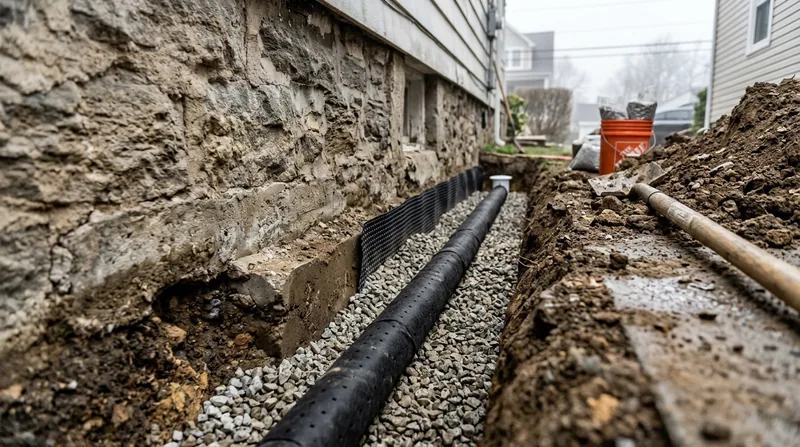




French Drain Installation in New York City
If your cellar floods every time a nor'easter rolls through or a summer downpour dumps two inches in an hour, you need French Drain Installation in New York City done right. This city sits on fill, glacial sand, and clay over bedrock schist, and the water table runs shallow near the harbor and the tidal rivers. In Brooklyn's Park Slope and Bay Ridge rowhouses, Queens' Forest Hills Tudors, and the stone foundations of Riverdale and St. George, groundwater finds every seam. We install exterior drains that intercept that water before it reaches your lower level. Basement waterproofing starts with moving water away from the wall, not painting the inside of it.
Why French Drain Installation Matters in New York City's Older Neighborhoods
Most of this city was built before modern drainage was a thought. Pre-war brick rowhouses in Bedford-Stuyvesant and attached homes in Jackson Heights sit on old stone and brick footings with no footing drain at all. The ground around them is often fill that compacts unevenly and holds water against the foundation. When the water table rises after a storm, hydrostatic pressure pushes moisture through mortar joints and hairline cracks. That is why you see efflorescence on cellar walls and smell a musty basement in June.
- Water pools against the foundation because the yard slopes back toward the house on many Queens and Staten Island lots.
- Downspouts dump roof water within two feet of the wall instead of extending away from the footing.
- Old clay or cast-iron drain tile collapses or clogs, so the original footing drain stops working.
- Freeze-thaw cycles open cracks in parging and masonry every winter, giving water a direct path inside.
A properly installed exterior drain intercepts that groundwater before it ever touches the wall. On lots where excavation is impractical, an interior drain tile system is often the smarter answer, and we will tell you plainly which one your basement actually needs.
Key info: In Bay Ridge and Sheepshead Bay, the water table sits close to the surface and tidal surge pushes it higher during nor'easters. A French drain tied to a sump basin with a check valve handles that surge far better than a shallow surface drain.
Before any work begins, it helps to understand what your local building department requires for drainage alterations. In New York City, the Department of Buildings publishes permit and filing guidance at nyc.gov/buildings, and rules vary by borough and by whether the discharge ties into the sanitary system.
How We Install a French Drain on a New York City Foundation
We start by walking the property and reading the grade. We check where water actually ponds, how the downspouts discharge, and whether the old drain tile is still flowing. On a 1920s brick Colonial in White Plains or a split-level in Valley Stream, the answer is often a combination of exterior drain and a new sump basin. We do not guess. We dig test pits and watch the water before we quote a linear footage.
- We mark the utility locate and confirm the excavation path along the foundation wall.
- We excavate a trench with a proper slope, typically 18 to 24 inches deep and 12 inches wide.
- We line the trench with filter fabric so glacial clay and silt do not clog the gravel.
- We set perforated pipe with the holes down, surrounded by washed gravel.
- We tie the drain to daylight, a dry well, or a sump basin, depending on the grade.
- We backfill with gravel and soil, then restore grading so surface water still runs away from the wall.
Every drain we install gets a fabric wrap and a cleanout, because a French drain you cannot inspect is a French drain you will replace in ten years.
Key info: On a sloping lot in Riverdale, we ran the drain to daylight at the curb because the grade dropped six feet across the yard. On a flat lot in Hempstead, we tied the same system to a sump basin and a discharge line instead, because there was nowhere for gravity to take the water.
If your drain ties into a sump basin, pair it with a sump pump installation sized for the volume your drain will actually move. A drain without a working pump is just a wet trench.
French Drain Approaches We Use
| Approach | Description | Best for |
|---|---|---|
| Exterior footing drain to daylight | Perforated pipe in gravel along the footing, sloped to a lower grade point. | Sloping lots in Riverdale, St. George, and the Westchester suburbs. |
| Exterior drain to dry well | Drain discharges into a gravel-filled pit sized for local soil percolation. | Flat Nassau County lots in Garden City and Mineola. |
| Exterior drain to sump basin | Drain feeds a sealed basin with a pump and check valve that discharges above grade. | Low blocks near the harbor and tidal rivers where the water table stays high. |
| Interior perimeter drain | Channel cut along the inside of the footing, leading to a sump basin. | Finished basements and brownstones where exterior excavation is not practical. |
| Drain tile repair and replacement | Clearing or replacing failed clay or cast-iron tile along the footing. | Older homes where the original weeping tile has collapsed or clogged. |
We match the approach to the soil, the grade, and the water table, not to a template. Two houses on the same block in Forest Hills can need two different drains.
French Drain Installation Cost in New York City: What to Expect
Most exterior French drains start around $25 per linear foot and climb from there. That figure covers a standard trench, filter fabric, perforated pipe, and gravel backfill. It does not cover a sump basin, a pump, a dry well, or concrete or paver restoration, and those add real money. On a 60-foot run along a Brooklyn rowhouse, the base number is only the beginning of the conversation.
Several factors move the price. Access is the big one: a narrow side yard in Bay Ridge or a shared driveway in Jackson Heights means hand digging, not a machine. Depth matters too, since a deeper trench for a high water table means more excavation and more gravel. If the drain has to tie into a sump basin or run to a distant daylight point, the linear footage grows. And if we find failed drain tile, collapsed footing, or a bowing wall while we are in the trench, that has to be addressed before the drain can work.
This is why we recommend getting two or three written estimates and comparing scope, not just the bottom line. A cheap quote that skips the fabric wrap or the cleanout will cost you more in ten years. Our full pricing overview breaks down what each line item includes so you can compare apples to apples.
What to Look for When Hiring a Waterproofing Contractor Near New York City
French drain work is only as good as the crew that digs the trench. Ask for proof of licensing and insurance before anyone touches your yard, and get a certificate of insurance sent directly from the carrier. Ask how long the company has worked on pre-war masonry foundations in this city, because a contractor who mostly does new construction will misread an old stone footing every time.
Get at least three estimates in writing, with the linear footage, pipe type, and discharge method spelled out. Ask for references from jobs in your borough and call them. Confirm who pulls any required permit and whether the discharge connection needs a filing with the local building department. If your property is in a historic district or has protected trees, check those requirements before excavation starts.
When you are ready to talk through your basement, contact us for a free inspection. We will tell you what the water is doing and what it will take to stop it.
French Drain Installation in New York City: Pricing Guide
| Service | Price | Details |
|---|---|---|
| Exterior French drain, standard run | Starting at $25/linear ft | Includes trench, filter fabric, perforated pipe, and gravel backfill along the footing. |
| Exterior drain tied to sump basin | Starting at $45/linear ft | Adds sealed basin, pump, check valve, and discharge line above grade. |
| Drain to dry well | Starting at $38/linear ft | Adds a gravel-filled dry well sized for soil percolation on flat lots. |
| Interior perimeter drain | Starting at $40/linear ft | Channel along inside footing to sump basin, best for finished basements. |
| Drain tile repair or replacement | On estimate | Depends on how much failed clay or cast-iron tile must be exposed and replaced. |
| Travel and estimate | Included / Free | No call-out or mileage fee in New York City; written estimate within 24 hours. |
Indicative pricing, the exact cost depends on square footage, finish, and site access. Free personalized estimate within 24h at (929) 392-2158.


